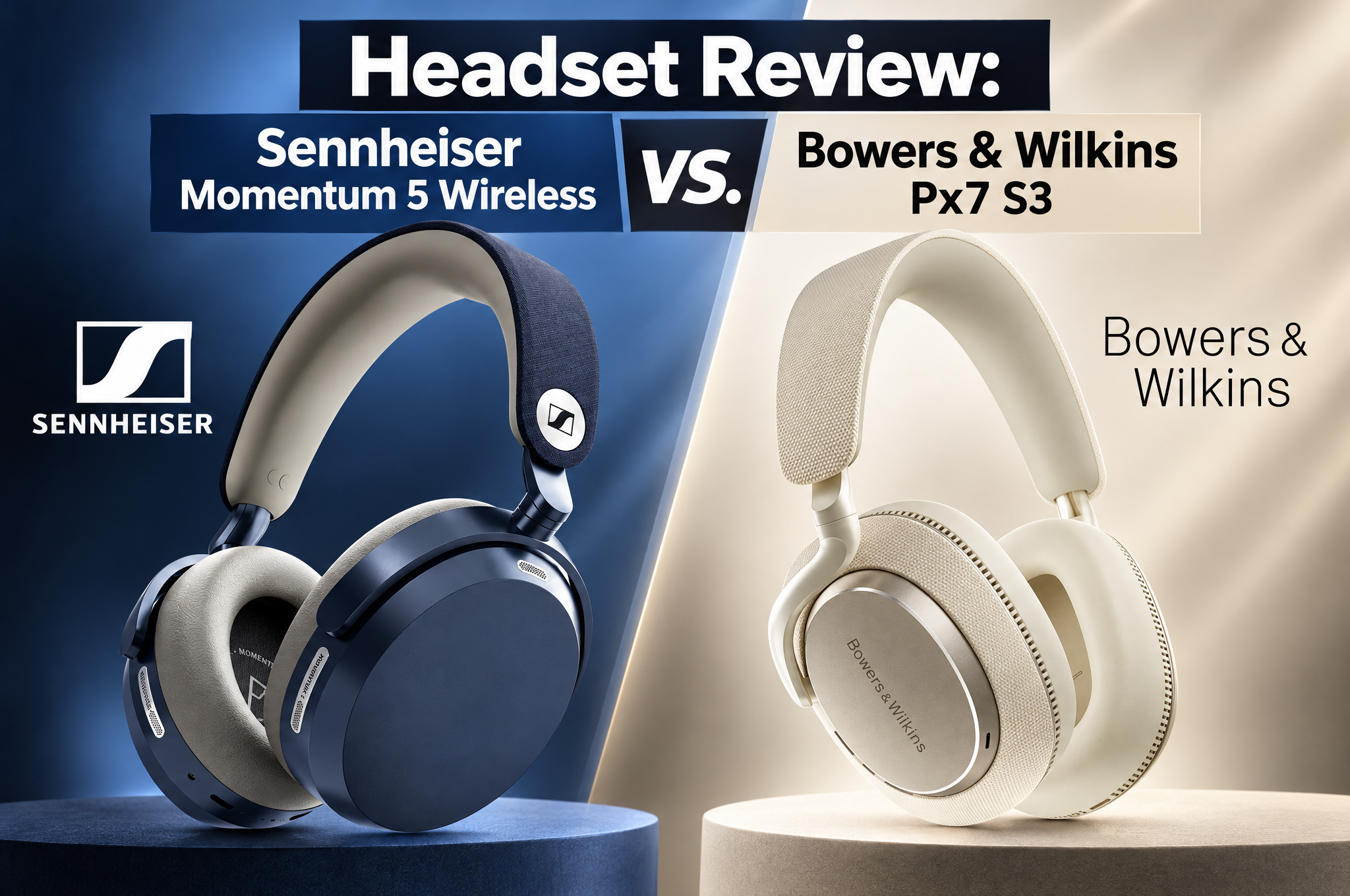
Sennheiser Momentum 5 Wireless vs. Bowers & Wilkins Px7 S3: which premium ANC headphones deserve your head?
Some comparisons refuse to produce a winner. This is one of them. Both headphones have eight microphones, both stream aptX Lossless, both cost roughly 400 euros. And yet they behave like two guests at the same party. One is already doing the dishes. The other is holding court by the fireplace. Honestly, both are welcome.
Same price tag, different philosophies.
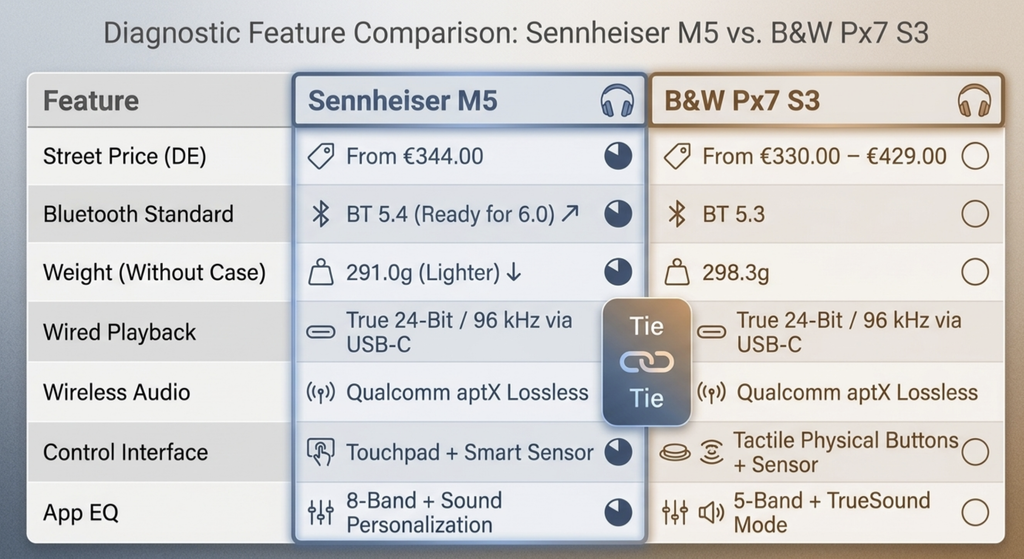
The Sennheiser Momentum 5 lists at 399.90 euros, with German street prices from around 355 Euros (Amazon Affiliate). The Px7 S3 launched in April 2025 at 429 euros, you could get it now at Amazon for 229 EUR. Sennheiser bet on features, endurance and repairability. B&W bet on materials, mechanics and musicality. One is the engineer, the other the tailor. Both support SBC, AAC and the whole aptX family up to aptX Lossless, so the codec argument is off the table.
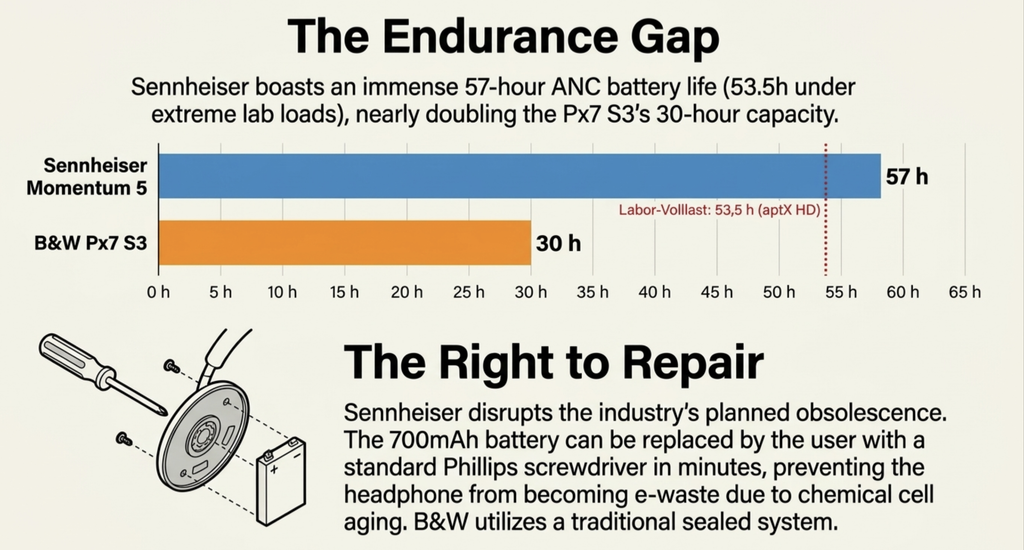
57 against 30. And a screwdriver.
This round is decided without much drama. The Momentum 5 runs up to 57 hours with ANC on, and one lab test still measured 53 hours and 28 minutes. Ten minutes of charging buys seven hours. The Px7 S3 manages around 30 hours. Perfectly fine. Just modest next to the Sennheiser.
The real twist: a 700 mAh battery you can swap yourself with a Phillips screwdriver. No service center, no sad farewell after three or four years of cell aging. In a category where expensive headphones tend to become e-waste, that is simply smart.
Silence, please.
Sennheiser doubled the microphone count compared to the Momentum 4 and claims voices are dampened up to three times better. In reviews, the Momentum 5 isolates more thoroughly on trains, planes and in open-plan offices. It doesn’t quite reach Sony, Bose and Apple, but in this duel it is clearly ahead.
The Px7 S3 removes an estimated 90 to 95 percent of background noise in offices and cafés. Outdoors and against human voices it reaches its limits sooner, because B&W tunes the ANC conservatively. Transparency mode is a close call: Sennheiser reworked it for a natural sound with almost no hiss, and the B&W version is convincing too. The Momentum 5 also adds automatic wind noise reduction.
But for phone calls, the tables turn. The Px7 S3’s ADI Pure Voice keeps your voice present while filtering out traffic and chatter, and reviewers rank it above the Momentum 5. Day full of video calls? Advantage Britain.
Bass, bloom and bounce.
The Momentum 5 builds a deep sub-bass foundation with real physical pressure, a bit like a cinema in your ear canal. The stage is wide and airy. Add Dolby Atmos with head tracking and a gaming mode, and films come alive.
The Px7 S3 plays tighter, faster and more rhythmic. Double bass and kick drum are drier and more precisely drawn, voices warm and dense, the treble silky. It also gets seriously loud without distortion. (Both now support 24-bit/96 kHz over USB-C. Sennheiser finally fixed the Momentum 4’s 16-bit limit.)
The mids and highs tell a similar story. Measurements put the Px7 S3 within ±1.5 dB of the Harman target between 100 Hz and 10 kHz, which is tighter than Sony’s WH-1000XM6. The Momentum 5 opens the midrange more airily and sets livelier accents on cymbals and bells. The Px7 S3 trades that last bit of sparkle for fatigue-free listening over hours.
One more thing about space: the Px7 S3 builds a natural, almost holographic stage purely from its angled drivers. The spatial audio mode that B&W added later by update is, by contrast, rather flat. Sennheiser’s Dolby Atmos is the more complete package, even if purists will stay in plain stereo for music.
Short version: electronic music, hip-hop and soundtracks for the Sennheiser. Jazz, funk and singer-songwriters for the B&W. Your playlist already knows the answer.
Microphone Quality
Please take your time and listen first to my voice samples of both headsets:
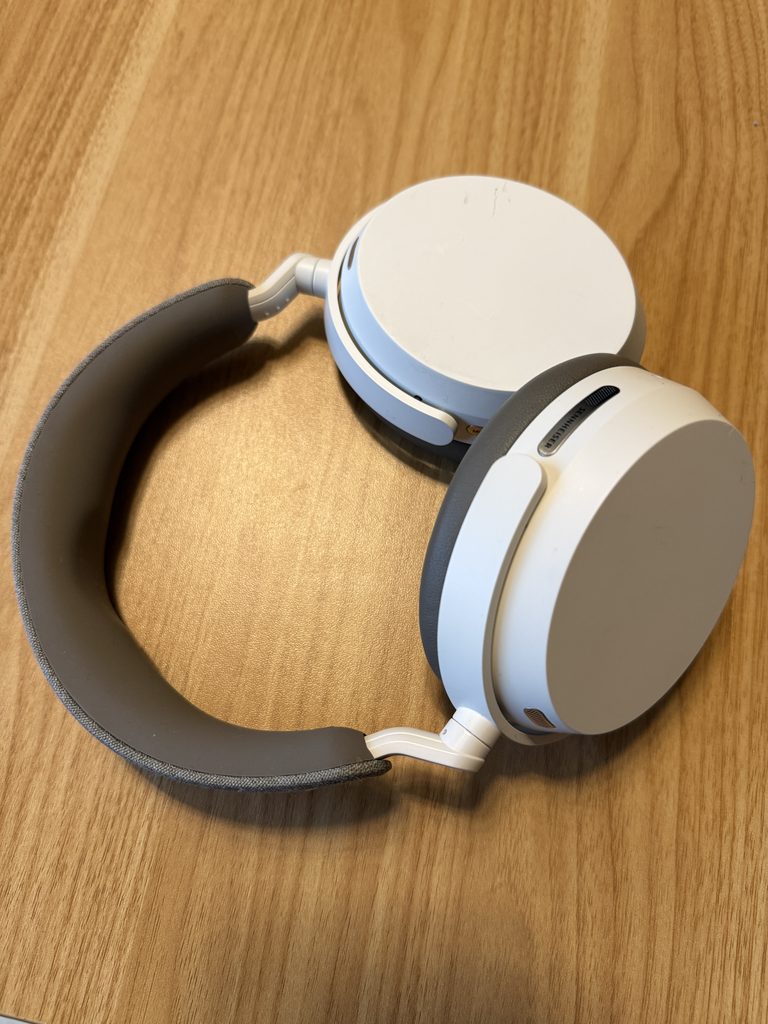
Sennheiser Momentum 5
B&W Px7 S3
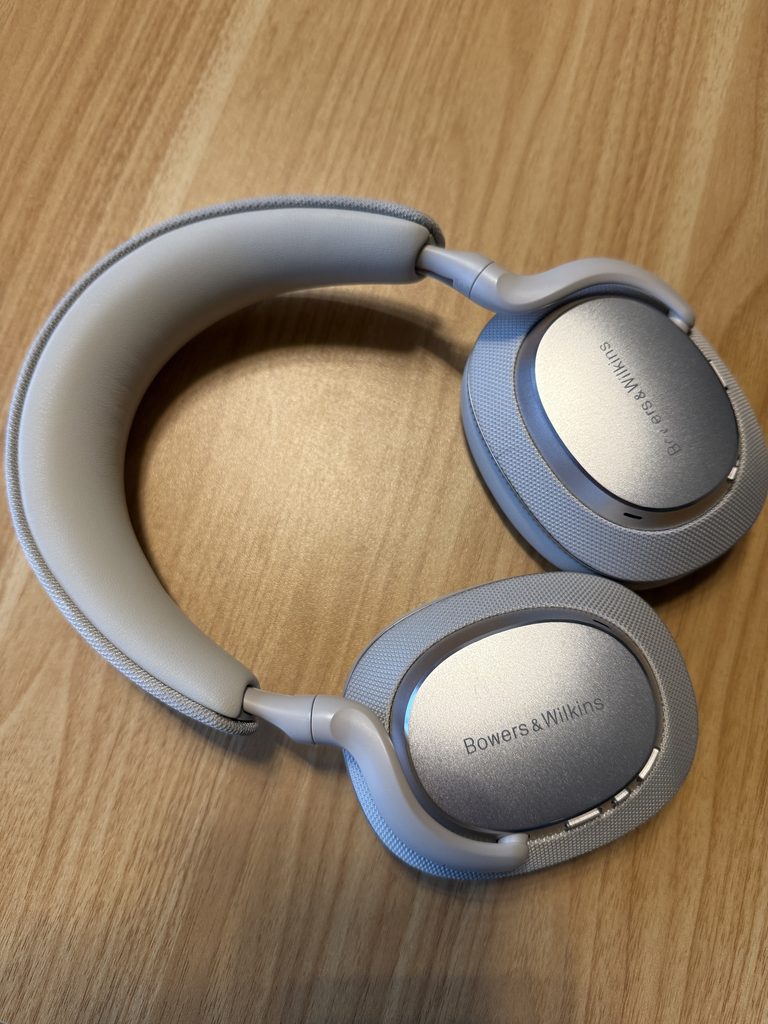
In my tests,both headsets are capped at about 8 kHz, which is typical of Bluetooth call audio, so neither delivers high-fidelity voice. The Sennheiser Momentum 5 sounds warmer and fuller, with about 9–12 dB more low end and stronger upper mids, which helps clarity but adds some boominess. The B&W Px7 S3 is leaner and tighter, with a more controlled low end and cleaner gaps between words, suggesting stronger noise suppression. The B&W’s cleaner background may come at the cost of a slightly processed, thinner voice, and it let some noise through before the speaker started. Sennheiser is clear winner here.
Touch, click and a bit of clamping.
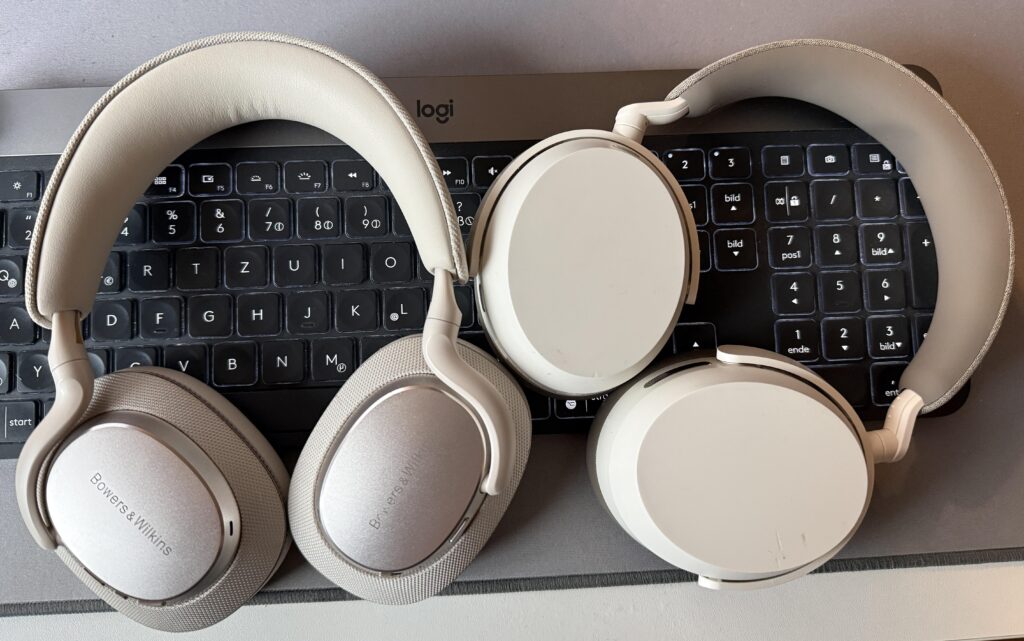
The Px7 S3 clearly feels like the more luxurious product: fabric, vegan leather, aluminum, and a hinge that survived 15,000 open-close cycles in the lab. The Momentum 5 is more understated, although the new Bronze and Lavender versions are much more fashionable than before.
Comfort goes to the Sennheiser. It distributes pressure better than its predecessor and stays comfortable for hours, even with glasses. The Px7 S3 starts with a firmer clamping force and needs a few weeks to loosen up. Buttons win when you run for the train, touch wins when you like swiping.
Nobody is perfect, of course. Some Momentum 5 owners find the ear pads a bit flat, and ears can warm up over time under the faux leather. A few Px7 S3 owners report a slightly rattling power slider and an occasionally moody wear sensor (which can be recalibrated in the app). On the plus side, the Momentum 5 switches on when you unfold it and pauses reliably when you hang it around your neck, and its case is 20 percent smaller than the Momentum 4’s. Small things, but travel days are made of small things.
So, who gets what?
- Commuters, frequent flyers, bass fans, sustainability fans: Momentum 5.
- Jazz and rock listeners, call-heavy business users, loud listeners: Px7 S3.
Both score 9.1 out of 10 in the RecordingNOW comparison, which sums it up nicely. The Momentum 5 is the more complete and cheaper package. The B&W Px7 S3 is the more charming one. Buy with your head: Sennheiser. Buy with your heart: at least give the Px7 S3 a test listen.
Enjoy your weekend. Possibly with headphones on.