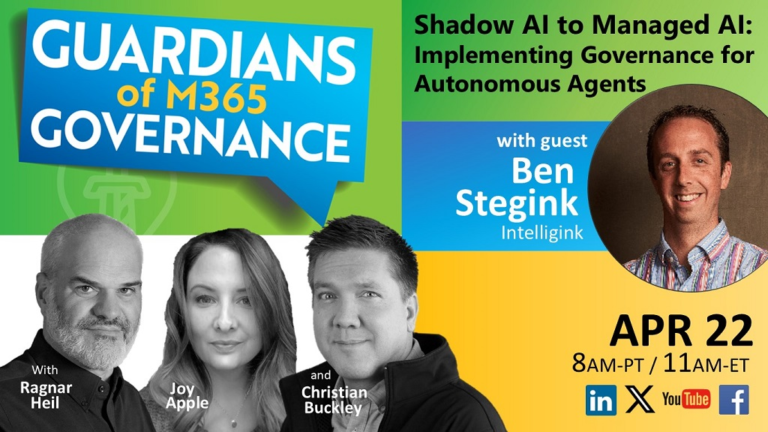
Shadow AI vs. Managed AI: Governance for Autonomous Agents in Microsoft 365
Your employees are already building autonomous AI agents – just not inside your tenant. Trying to solve Shadow AI with blanket bans only pushes users toward uncontrolled tools. In Episode 28 of Guardians of M365 Governance, I sat down with Christian Buckley, Joy Apple, and MVP Ben Stegink to discuss how to actually make the leap from Shadow AI to Managed AI.
Why Shadow AI Is the Old Yammer Problem in a New Dress
We’ve seen this pattern before: the harder IT locks things down, the more creative users get. As Joy put it perfectly – more governance means less usability, and that pushes people into the shadows. This isn’t new. It’s the direct continuation of the SharePoint-to-cloud debate: flatter architecture, more trust, better adoption.
With autonomous agents, the effect is massively amplified. An agent with full filesystem access is a different risk class than a ChatGPT browser window.
Supported vs. Allowed: The Most Important Distinction
Ben made a point that every IT strategy in 2026 will need: there’s a critical difference between “allowed” and “supported”.
- Allowed: You can use it – but the helpdesk won’t help you.
- Supported: We invest in training, the helpdesk responds, MCP setup is backed.
This is exactly where many organizations fail in practice. Many tolerate Claude in the browser, but Claude Code with full filesystem access is officially or unofficially blocked – without offering a clean alternative.
The Quality Gate Checklist for Autonomous Agents
Provisioning a new endpoint is trivial – it’s literally one Linux command. The real work is the Quality Gate that comes before. These six questions need to be answered for every agent approval:
- Value: Does the agent deliver real, measurable value?
- Cost Control: Are the costs predictable and capped?
- Security & Compliance: Are all MCP servers and connectors certified?
- Ownership: Are there enough owners for the agent?
- Lifecycle Management: What happens when an owner leaves the company?
- Data Classification: Which sensitivity levels can the agent access?
These conversations with security, compliance, business, and finance can’t be automated – but they decide whether your AI strategy succeeds or fails.
Practical Solution: Sandboxing Open-Source Agents
If you want to use open-source agents productively without putting your tenant at risk: I’m currently testing an HP zgx Nano G1N AI Station with NVIDIA hardware running Ubuntu Server, on which Nemo Claw operates isolated sandboxes. 128 GB allow several parallel sandboxes – every endpoint is blacklisted by default. Google Drive, Dropbox, OneDrive: all blocked initially.
This is NVIDIA’s recommendation for enterprise-compliant open-source agents. Trade-off: Less spontaneous fun, because every endpoint must be explicitly approved – but you get auditable security in return.
Agent 365 and DSPM: Microsoft’s Answer
Microsoft is launching Agent 365 on May 1st – autonomous agents will get an Agent ID and be treated like users. Concretely, that means:
- DLP policies applicable to agents
- Risk-based conditional access for agents
- Suspicious behavior triggers blocking of data or actions
Combined with Purview DSPM for AI, this finally creates a pragmatic middle ground: don’t block everything – but make strictly confidential data in private Claude or Gemini sessions auditable.
My Personal Setup: Separation Instead of Prohibition
I’ve never separated work and personal life on traditional tools. With AI, I do it deliberately: Microsoft 365 Copilot for work, Claude for personal use. The reason isn’t compliance, it’s memory – I want to keep each AI’s knowledge base clean. This separation is also a governance pattern you can recommend to your end users.
Bottom Line: Talk, Don’t Block
The most important takeaway from Episode 28: the solution isn’t technological, it’s conversational. Microsoft Defender for Cloud shows you exactly which five users are using ChatGPT – but instead of shutting the tools down, talk to those five users. Understand the use case. Offer a compliant alternative.
Punish innovation, and you lose knowledge to the shadows. Channel it, and you gain adoption.
🎙️ Watch the full episode with Ben Stegink:
Listen to this episode in your favorite podcast player like Spotify:
https://open.spotify.com/episode/26UEeqKfxxLourJYEKzr1Z?si=G89RWtwtQ7Stgh7yNgd06w
📬 Want more on Microsoft 365 Governance? Subscribe to the channel so you don’t miss anything.
PS: Are you ready to implement solid governance for AI Agents? Contact me, Ragnar Heil, for advice on Agent 365, SharePoint Advanced Management, Microsoft Purview (Information Protection, Data Loss Prevention Policies, DSPM for AI), Rencore Governance, EasyLife365 Collaboration, ShareGate Protect, Data&More, or Agent 365 adoption strategies tailored to your organization. You can find my calendar here on our HanseVision Governance Landing Page.



2 Comments