AI Gateway or LLM Gateway? CData vs Azure Compared
Sooner or later, every AI project meets the bouncer at the door. Which model gets in? Which data? And who pays for the tokens? Without an AI gateway, every team answers differently. Keys sprawl. Bills surprise. Audit asks questions nobody can answer.
So which gateway fixes which problem? Azure AI Gateway or CDATA’s new Connect AI Gateway? Here is the quick, honest comparison.
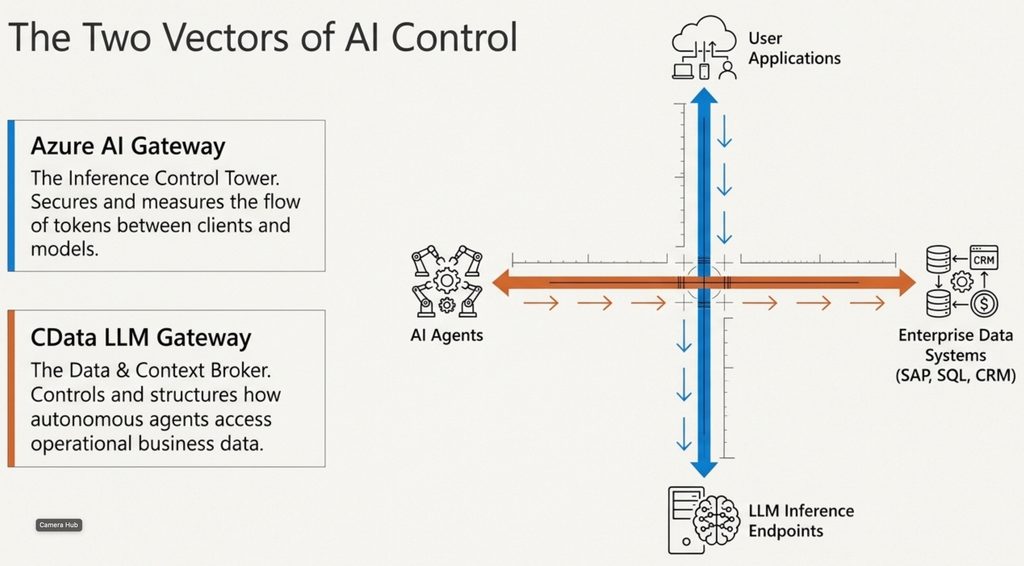
AI Gateway vs LLM Gateway: Two Directions, Two Vectors of AI Control
Azure AI Gateway is a managed gateway for models and MCP servers. It is in public preview. The older AI gateway capabilities in API Management remain supported.
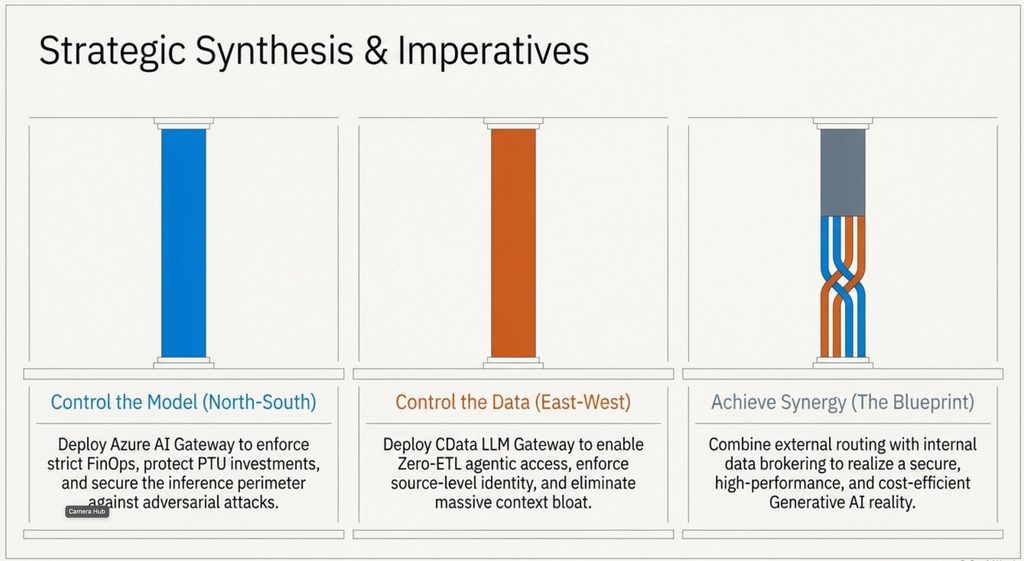
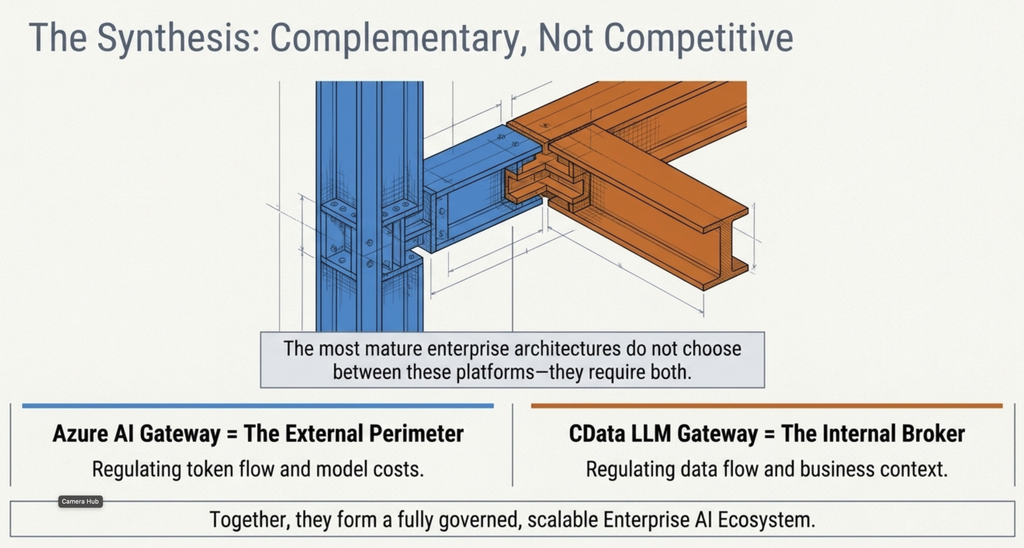
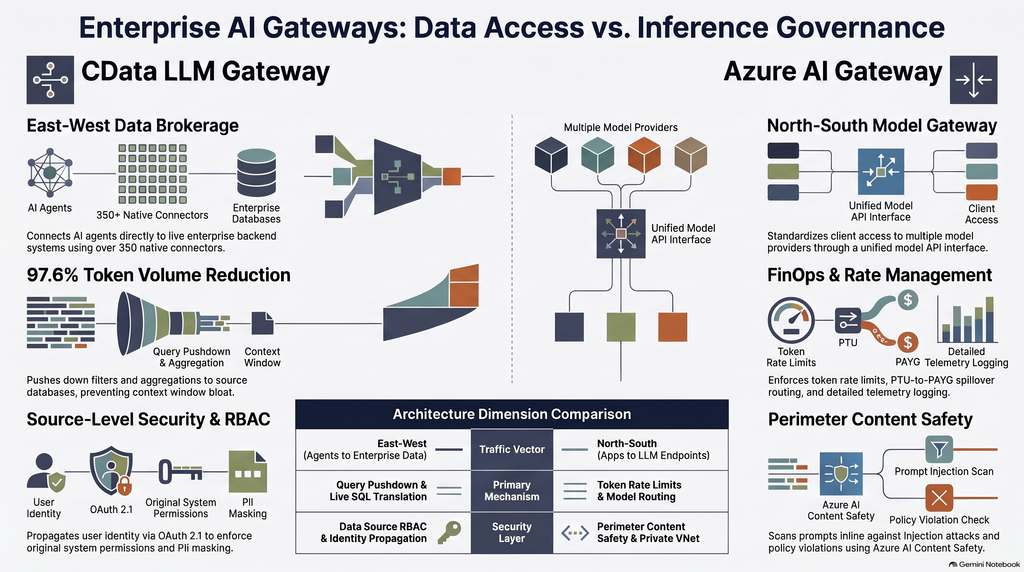
CData Connect AI (combining its LLM Gateway, MCP Gateway, and Context Engine) controls the east-west traffic between your agents and your enterprise data. It builds on CData’s library of 350+ connectors to give Copilot, Claude, and custom agents governed, zero-ETL access to live business records. While Azure watches the tokens and inference endpoints, CData governs the tables, tools, and business context.
CData LLM Gateway: Context, Not Just Routing
- Context on every request. Schemas, metric definitions and company knowledge are applied before the model answers.
- Fewer tokens, not just cheaper ones. Joins, filters and calculations run in the platform. The model sees only the result.
- Live data with permissions. Masking and row-level security apply before results reach an external model.
- Model-agnostic failover. If a provider degrades, the request moves on with the same context.
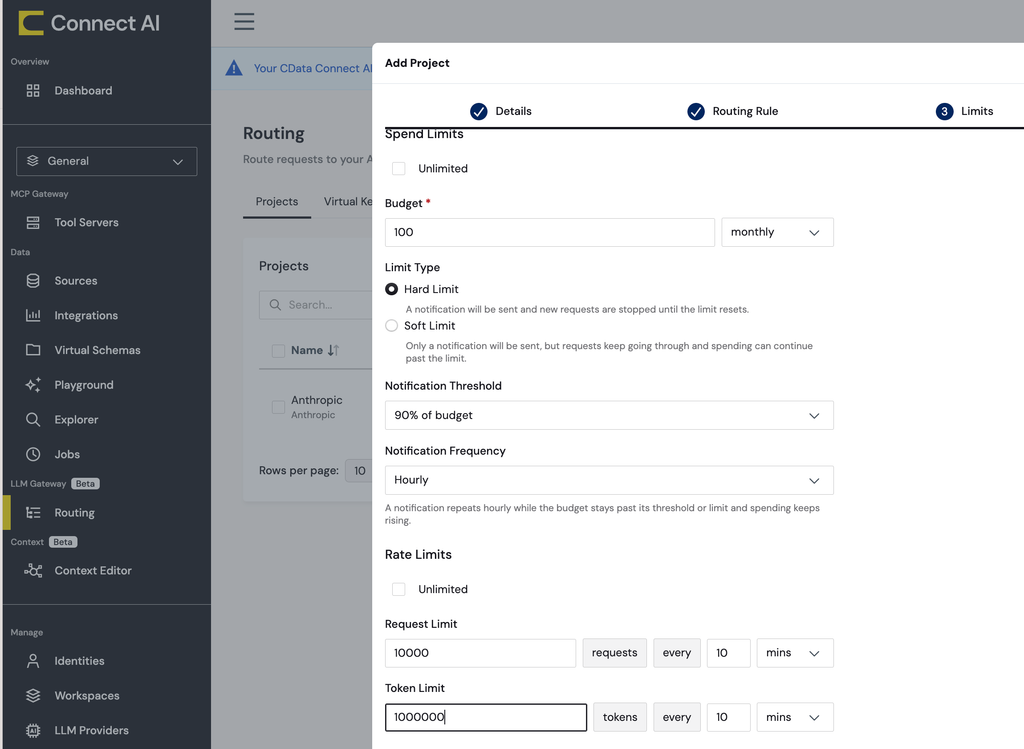
- Drop-in migration. This LLM gateway is compatible with dozens of LLM Providers (like OpenAI, Anthropic, GitHub Copilot, X AI, Azure OpenAI, Google Gemini, Ollama etc). You change a base URL and key. In this screenshot I am setting spending budgets for Anthropic:
Where it beats Azure AI Gateway: While Azure can federate OpenAPI specs, Logic Apps connectors, or existing MCP servers, it acts as a passive pass-through—leaving schema management, API development, and data bloat on your plate. CData Connect AI provides an active Virtual Data Layer across 350+ systems. Instead of dumping massive raw tables into your LLM’s context window, CData executes filter push-downs, joins, and aggregations directly at the source. This slashes prompt token bloat by up to 97%, prevents hallucinated schemas, and propagates individual user permissions down to row and field levels without moving data to an intermediate store.
When You Need Azure AI Gateway
CData’s pages do not document several Azure strengths. Check them before you assume:
| Capability | Azure AI Gateway | CData Connect AI (LLM / MCP Gateway) |
|---|---|---|
| Token limits per consumer | ✅ llm-token-limit policy | ➖ Budgets and rate limits per project & team (no Token per User) |
| Token metrics and monitoring | ✅ Azure Monitor, Application Insights | ➖ Spend tracking per person and project |
| Semantic caching | ✅ Azure Managed Redis vector cache | ❌ (Focuses on live source data freshness) |
| Load balancing, circuit breaker | ✅ Round-robin, weighted, priority | ➖ Complexity-based model routing & failover |
| Content safety on prompts | ✅ Azure AI Content Safety | ❓ Guardrails, details not documented |
| Enterprise network isolation | ✅ Native Azure VNet, Private Link, Self-hosted | ➖ SaaS endpoint with on-prem reverse tunnel |
| Enterprise data connectors | ➖ Bring your own APIs | ✅ Hundreds of sources |
| Prompt injection & content safety screening | ✅ llm-content-safety policy | ❌ (Focuses on data masking & source ACLs) |
Choose Azure when you run many apps on Foundry models, share PTU capacity, need per-department cost views, or hear “private endpoint or nothing.”
Myth: One AI Gateway Does It All
A model gateway is not a data integration platform. A connector platform is not a FinOps tool. Let one gateway do the other’s job, and you build workarounds.
How to Combine Both Gateways
- Decide who owns which gateway: platform team or data team.
- Put Azure in front of your models. Set token limits, metrics and caching.
- Connect your agent orchestrator (Microsoft Copilot Studio, Azure AI Foundry Agent Service, or Claude) to both. Inbound prompts route through Azure AI Gateway for content safety checks, rate limiting, and semantic caching before reaching the foundation model. When the model triggers a tool call for enterprise context, the agent invokes the CData Connect AI MCP endpoint, which runs live, permission-scoped queries at the source. The agent feeds this lean, filtered context back through Azure to complete the generation.
- Point agents at both. Monitor token costs in Azure and data access in CData.
Want a second opinion on your architecture? DM me.
What Early Adopters Report
Anaqua’s CIO reports six to eight weeks from evaluation to company-wide rollout. CData Labs claims 98.5% accuracy versus 65–75% for other MCP providers. Both are vendor claims. Test with your own data.
FAQ
What is the difference between Azure AI gateway and CDATA Connect LLM gateway?
CDATA Connect AI Gateway routes and controls model requests. Azure AI gateway also covers tools, agents and data.Does the CData LLM Gateway replace Azure AI Gateway?No. CData adds context and data governance. Azure adds network and identity control.Which gateway first?Start with CData if agents need business data. Start with Azure if you scale models across teams.
Both are early: early access versus public preview. Pilot first.
PS: Ready to implement proper AI agent governance? Contact me, Ragnar Heil, for a consultation on Agent 365, SharePoint Advanced Management, Microsoft Purview (Information Protection, Data Loss Prevention Policies, DSPM for AI), EasyLife365 Collaboration, Solutions2Share, Rencore Governance, ShareGate Protect, Data&More or Agent 365 deployment strategies tailored to your organization’s needs. Find my calendar here at our HanseVision Governance Landing Page. Pssst… I am also offering an exquisite M365 Copilot & Agents MasterClass. Find out more here.